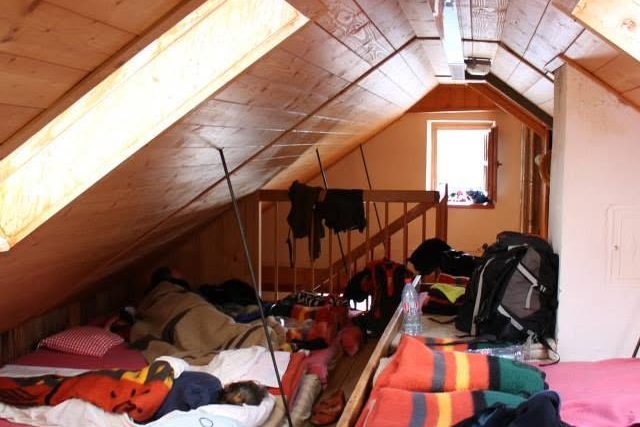
"The hut has beds free" is less informative than it sounds. Huts sell several quite different things, and a night that shows as available may be available only in a form you would not have chosen.
The options, roughly from cheapest
The communal dormitory. Called a Matratzenlager, dortoir, camerata or lager. A room of bunks or a continuous mattress platform, anything from six people to forty, mixed, with an allocated place rather than a choice. This is the standard alpine hut bed and what most hut capacity actually is.
The small dormitory. Same idea, four to eight beds. Sometimes bookable as a unit for a group, sometimes just a smaller room you get allocated to.
The private room. A Zimmer, chambre or camera, two to four beds, door that shuts. Some huts have a handful, many high huts have none at all. Substantially more expensive, and at popular huts these go first because a certain kind of guest books nothing else.
Camping or a bivouac pitch. Some huts, particularly on the French side, sell tent pitches with access to the hut's facilities and meals. It is a completely different night from a bed indoors.
The winter room. Unstaffed shelter, open when the hut is closed. Not a booking and not comparable - see the note at the end of your first night in an alpine hut.
The trap: "available" without a type
This is worth spelling out, because it catches people and it is the reason we built a specific feature for it.
Many hut booking systems report one availability flag for a whole night, collapsing every product into a single yes or no. A hut whose dormitory is completely full but which still has one expensive private room, or a tent pitch, reports that night as available. If you are planning a chain of six nights and the third one is "available" only as a camping pitch, you do not have the trip you think you have.
Where the underlying booking system exposes the breakdown, HutScanner reads the per-night room types and lets you exclude nights that are camping-only or private-room-only, so a night counts as available only if there is an actual dormitory bunk. Both filters are on by default, because a dormitory bunk is what almost everybody is looking for.
That detail is not available from every booking platform. Where it is not, we show what the system tells us rather than guessing, and the hut's own page is the place to confirm.
Choosing between them
Take the dormitory if you are doing a multi-day route. It is what the huts are built around, it is the sociable part of hut life, and on a long trip the cost difference across a week is significant. Bring earplugs and a liner and you will be fine.
Consider a private room if you sleep badly in company and the trip depends on being functional the next day, or if you are travelling as a couple or family and would rather not be split across a dormitory allocation. Book it early - there are very few, and they are the first thing to go.
Do not count on camping as a fallback unless you have checked that specific hut offers it and that you are allowed to use the hut's kitchen and facilities. Wild camping rules vary sharply by country and in several parts of the Alps it is restricted or prohibited.
What to bring either way
A sleeping bag liner is required in dormitories almost everywhere, and usually in private rooms too. Blankets and pillows are provided; sheets are not. A full sleeping bag is unnecessary weight in a staffed hut.
Earplugs in a dormitory, always. A head torch for finding the toilet at 02:00 without waking the room, and pointed at the floor when you do.
When booking
Say which you want, explicitly. If you are booking through a portal it is a selection on the form and easy to click past. If you are booking by email - which a quarter of the huts we track still use - write it in the message along with your dates, party size and whether you want half board.
HutScanner shows the walking network across the Alps with live-checked availability, including per-night room types where the booking system provides them, so you can find a chain of nights that all have the kind of bed you actually want. You book directly with each hut; we are a planning aid, not a booking service.