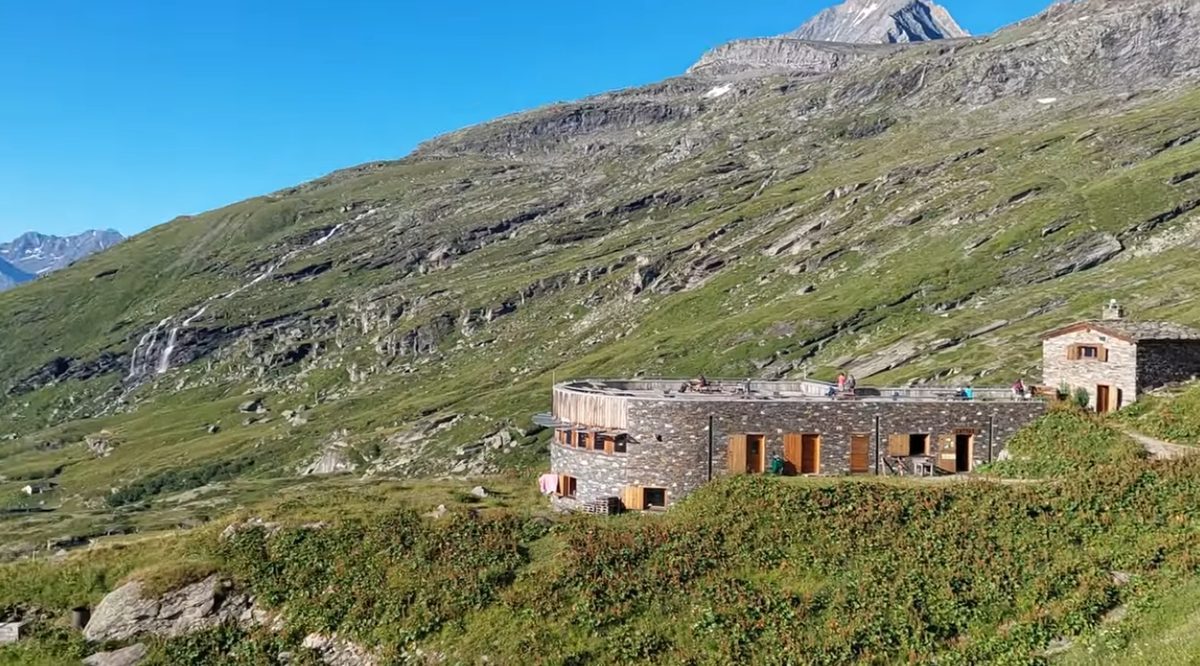
Walking from hut to hut across the Alps is one of the best things you can do with a week. You carry a light pack, you sleep somewhere with a roof and a cooked dinner, and you wake up already high in the mountains. There is no tent, no stove, and no week of food on your back.
The planning is the part that puts people off, and it is genuinely more awkward than it should be. This page is the order to do it in, with links to the detail on each step.
If you would rather see it than read about it: open the planner on the Vanoise - a quieter massif than the famous circuits - pick your dates and how many nights you want, and it will show you chains of huts that have beds on consecutive nights and are a day's walk apart. That is the hard part of everything below, done for you in a few seconds. The rest of this page is why it matters and what to do with the answer.
1. Pick the massif before the dates
This is the decision that determines everything else, and most people make it backwards by starting with a famous name.
The availability difference between mountain ranges is enormous. Over the 30 nights following 6 August 2026 the Tour du Mont Blanc ran 57.3% of hut-nights full while Valais and Zermatt ran 7.5% and Ticino 10.5%. That is not a small edge - it is the difference between a trip you can book this month and a trip you should have booked last autumn.
So ask yourself honestly which you want:
- A specific famous route, because the name matters to you. Fine, but book the autumn before and accept the constraint.
- A week of good hut-to-hut walking this summer. Then go where the beds are. Where alpine huts still have space lists the open regions and what they are like.
For a first trip, a quieter massif is also easier walking politics: fewer people on the cols, more room at the table, and a warden with time to talk to you.
2. Be realistic about a day
The single most common first-trip mistake is planning by distance. Hut-to-hut days are governed by ascent, not kilometres.
A sensible first-trip day is roughly 5 to 7 hours of walking with 700 to 1,000 m of climbing. Twelve kilometres with 1,300 m of ascent is a much bigger day than twenty kilometres along a valley, and doing it four days running is different again from doing it once.
Check the ascent per leg, and build in one shorter day. If your route has a rest day or a short stage, put it on the Saturday - see step 4.
3. Know your terrain ceiling
Alpine paths are graded T1 to T6 on the Swiss Alpine Club scale. Most hut-to-hut walking is T2 and T3, and the step to T4 is where walking becomes light mountaineering.
For a first trip, T3 is a sensible ceiling, and you should know that a route is graded by its hardest few hundred metres rather than its average. About one leg in five in our data has a T4 or harder section somewhere on it, usually short and usually near the col.
Two things that are hazards rather than difficulties, and should be treated separately:
- Glacier crossings appear on about one leg in nine. A glacier needs a rope, crevasse-rescue skills and a partner. It is not "a hard walk", and it is not for a first trip.
- Via ferrata sections are rare - under 1% of legs - but need a harness, a proper energy-absorbing lanyard and a helmet.
Full detail in the SAC hiking scale explained and via ferrata grades explained.
4. Build the chain, then book it
A hut-to-hut trip is a chain: every night has to have space, in sequence, with each hut walkable from the one before. One full hut in the middle breaks everything after it.
Work out the whole chain before contacting anybody. Booking one hut at a time in trail order is how a plan takes three weeks and still falls apart.
This is the step HutScanner was built for. Open the planner, choose a region and a date window, and the route finder searches for sequences where every night has a bed at a hut you can walk to from the one before - including shifting the dates or swapping in a neighbouring hut when one is full. The three rules below are what it is doing under the hood, and they are worth knowing whether you use it or a spreadsheet.
Move any night that lands on a Saturday. Across the nights we track, 35.3% of huts were full on a Saturday against 18.3% on a Sunday. Shifting one night is the cheapest thing you can do for your chances. See when do alpine huts actually fill up.
Book the tightest night first - the smallest hut, on the busiest night. A 20-bed hut is your binding constraint; a 120-bed hut is not.
Expect several different booking systems. Of the 4,563 huts we track, only about 7% take a booking fully online. A quarter work by email and a tenth by phone, across at least seven separate platforms that do not talk to each other. How alpine hut booking actually works explains why, and what to write.
If a hut you need is full, there is more to do than refresh the page: the hut you wanted is full.
5. Sort the practical details
Booking type. Say whether you want a dormitory place or a private room, and whether you want half board. Both are choices you can click past on a booking form. See dormitory or private room and half board in alpine huts.
Alpine club membership. If you are doing more than a few hut nights it usually pays for itself on the reduced member rates, and normally includes mountain rescue cover.
Cash. Many huts take cash only and there is no machine on the mountain. If your route crosses a border, that may be two currencies.
Insurance that covers mountain rescue, whether through a club or separately.
6. Pack light
You are not carrying a tent, a sleeping bag, a stove or a week of food. Blankets and pillows are provided; a sleeping bag liner is compulsory almost everywhere and is the most important non-clothing item you will carry.
A realistic summer week is 7 to 9 kg including water. Full list in what to pack for a hut-to-hut trek.
7. Know what a hut night is like
Boots off at the door, check in with the warden, dinner at a fixed time at long tables with strangers, lights out around 22:00, and an early breakfast. It is sociable, unpretentious, and much less intimidating than it sounds from outside.
Your first night in an alpine hut covers the conventions in full, and the alpine hut glossary translates the words you will meet on booking forms in four languages.
8. Navigation
Export the route as a GPX file, load it into whatever you navigate with, and download the offline maps before you leave signal. Carry a paper map and compass as well. Alpine cols frequently have no phone coverage, and that is precisely where you will want to check.
See using GPX files for a hut-to-hut route.
A sensible first trip
If you want the short version: pick a quiet massif rather than a famous circuit, plan four or five nights rather than ten, cap the difficulty at T3, exclude glacier legs entirely, avoid Saturdays in the huts you care about, and book the smallest hut first.
Those are all constraints you can hand to the planner rather than hold in your head. Open the planner, set the nights and the effort you want, and let it find the chains that fit - then come back to the steps above for the booking and the packing.
HutScanner maps hut networks across the Alps with the walking legs between them and live-checked availability, so you can see which chains of consecutive nights are actually open rather than checking huts one at a time. Routes are computed estimates over open mapping data, not surveyed trails - check them against an official map. You book directly with each hut; we are a planning aid, not a booking service.